
Feeding your baby can be both exciting and challenging in the first year. Capturing your child’s expressions when they first taste foods, deal with stomachaches, or discover allergic reactions can be quite overwhelming for new mothers. Knowing what to feed your child during the first year can help you better understand infant nutrition and also help you whip up a healthy baby diet plan for your little one.
Infant nutrition during the first months is important for your baby’s growth and development. Your breast milk is all the baby needs till about 4 to 6 months. Breast milk contains vital nutrients, including fats, proteins, carbohydrates, vitamins, and water required for your baby to grow. It also contains antibodies and immune cells, making it the best food for infants. Breast milk is easily digestible and provides all the nutrition your baby requires.
Complementing breast milk with formula milk may be recommended in case breast milk alone cannot meet your baby’s growing nutritional needs. Between 4 and 6 months, iron and zinc stores start to deplete, and your baby may start demanding more nutrition than breast milk alone can provide. Ask your pediatrician at Kinder Hospital Bangalore for advice on how to supplement your breastmilk with formula milk.
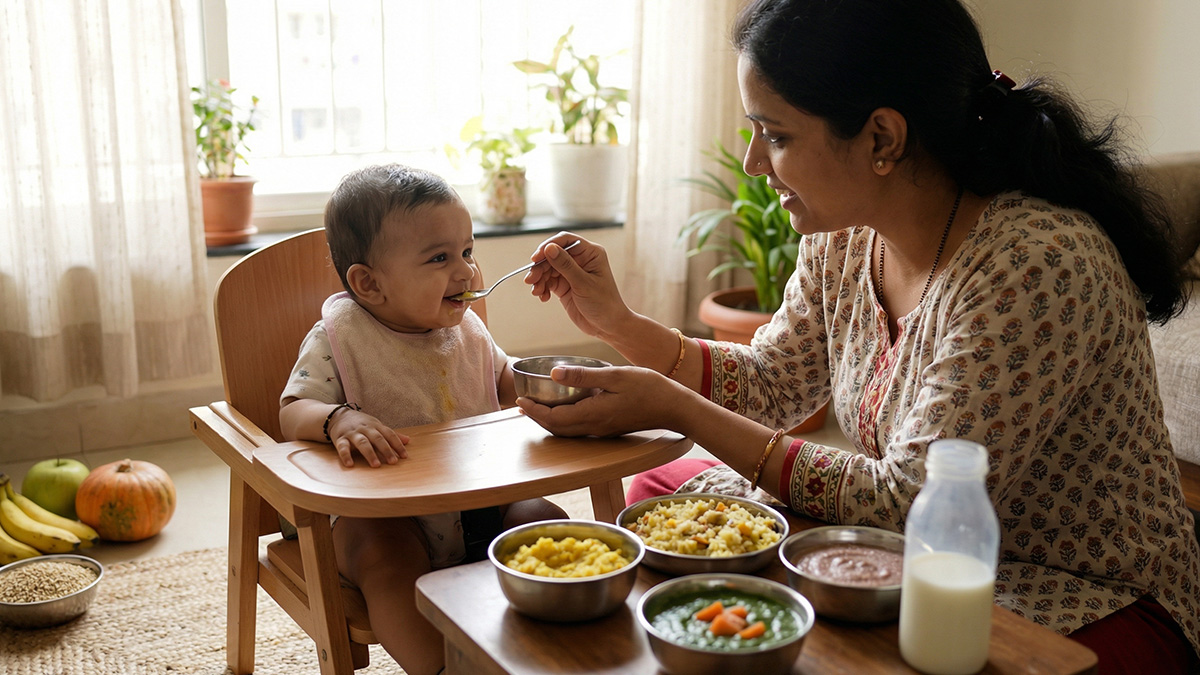
As mentioned, after 6 months, your baby’s nutritional demands will increase. You might notice signs that your baby is ready for solid foods. Signs like head and neck control, opening the mouth when food is offered, noticing others eat, and reaching out to grab food are evident signs that your baby is ready for solid food. Delaying the introduction of solid food beyond 6 months may result in nutritional deficiencies. So, your pediatrician will recommend introducing soft or pureed food in the 6th month, while continuing breastfeeding.
For a healthy baby diet, you can start with:
Between 6 and 8 months, you can practice responsive feeding. That is, feeding when your baby shows hunger cues. Baby food under one year can be offered on demand. Start with small portions once a day. You can gradually increase texture, variety, and quantity as your baby grows. Always remember to ensure your baby gets enough water to keep them hydrated throughout.
At 8 months, your baby has already developed preferences and may even start to throw tantrums when they dislike certain foods. This is the time to introduce different-textured food like
At 8 months, you can introduce a variety of foods up to several times a day depending on your baby’s demands. Continue breastfeeding during this period to supplement your child’s nutrition.
After 10 months and beyond, it’s time to introduce family food to your baby. So, everyday food like rice, roti, mild and non-spicy curries, vegetables, and fruits can go onto your child’s plate. Encourage self-feeding during this time. Self-feeding not only lets your child discover new foods, tastes, and textures but also helps develop fine motor skills and hand-eye coordination.
At Kinder Hospital Bangalore, we have a team of the best pediatricians and nutritionists supporting the growth of your child from birth. We provide month-by-month support for parents, ensuring they provide the best nutrition for their growing baby. Consult the top pediatricians and Kinder Hospital Bangalore for personalized feeding guidance. Our Level III neonatal care ensures expert support from birth. We are a leading children’s hospital with world-class infrastructure and facilities specifically designed for pediatric use. Trust Kinder Hospital in Whitefield, Bangalore, for your child’s health and well-being.
Most babies are ready for solids around 6 months. You can start with soft-textured and pureed food. However, it is advisable to continue breastfeeding as the main source of infant nutrition.
Pureed vegetables and fruits are ideal first foods for babies. Start with small portions and check for allergic reactions before increasing portions.
After 6 months, introduce new vegetables and fruits every 3 to 5 days. This helps your child get used to a variety of tastes while allowing you to notice any allergic reactions to particular foods.